
Insights
Why YTEC develops apps with React Native
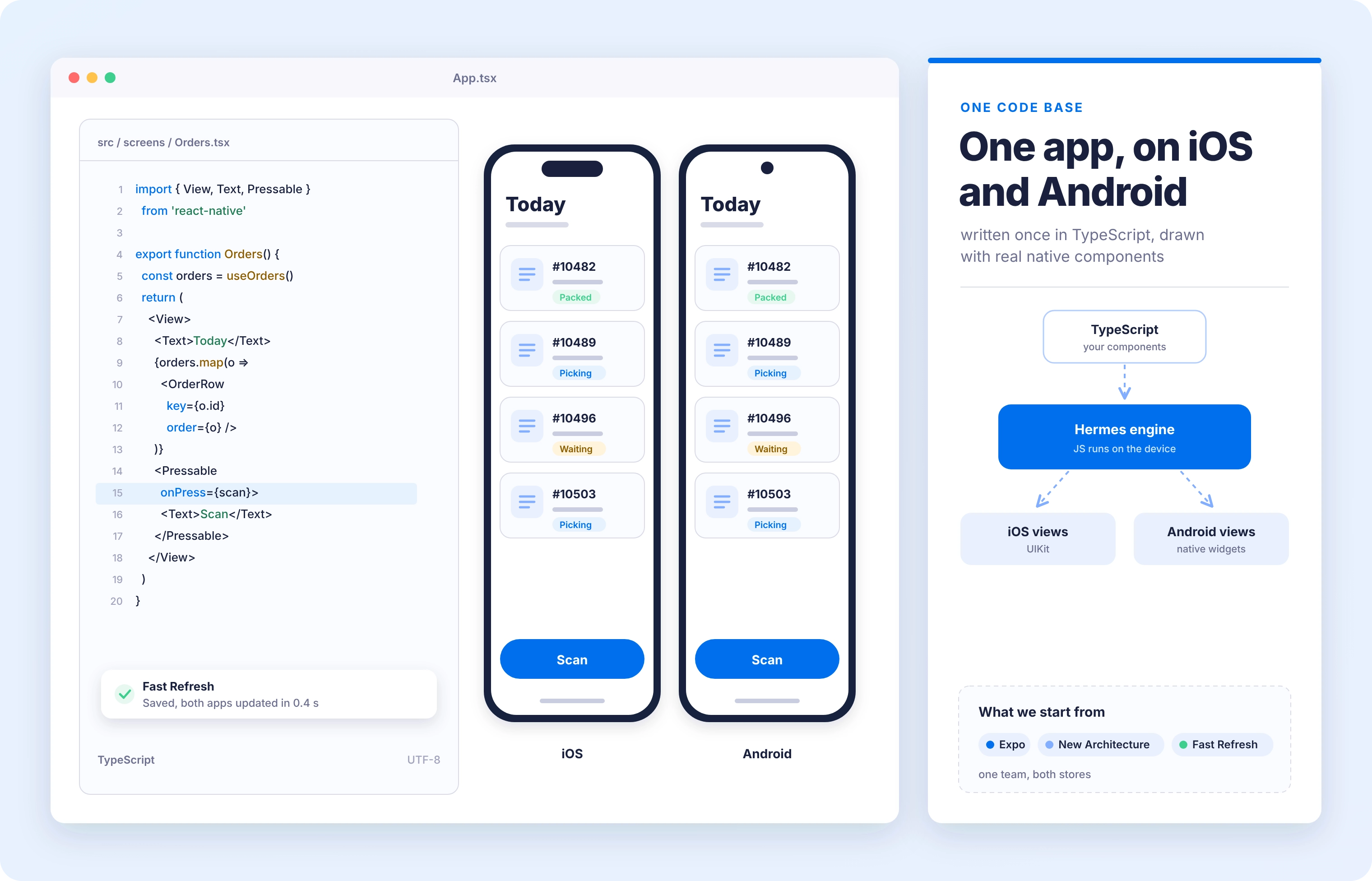
Before React Native, developing applications for mobile devices typically involved a lot of code duplication; Android applications are typically written in Kotlin or Java, whereas iPhone apps are written in Swift or, in older code bases, Objective-C. This meant that the same code could not be reused on different platforms. An alternative is developing a web application that runs in a browser on the device. Browsers have come a long way and you can add a web app to your home screen these days, but it is still difficult to achieve the same level of integration and ease of use as with a natively running app. Examples of limitations of browser-based apps are restricted background tasks, limited access to parts of the hardware and no place in the App Store or Google Play.
Besides taking more time to develop, having to maintain different application target platforms has an additional downside: programmers have to invest time to familiarize themselves with these different platforms and programming languages. YTEC continuously strives for as great a degree of overlap and redundancy between programmers’ skill sets as possible, because a skill which is mastered by only a single developer would compromise flexibility of planning. This is why YTEC is picky about which technologies are picked up and only embraces that which can be committed to company-wide.
For a while this meant we could not build apps for Apple devices ourselves, because we had little experience with Swift and Objective-C. For the iOS versions of our apps we had to hire external programmers, which made the lead time longer.
YTEC is not alone in having to deal with these issues. When Facebook had to confront these same issues (during the development of their Ads Manager app), they made use of a homegrown solution: React Native, which allows you to write one application for iOS and Android, while utilizing a language already familiar to all web developers: JavaScript, or TypeScript in our case.
React Native does not convert this code into Swift or Kotlin. The JavaScript runs on the device in Hermes, a JavaScript engine made for React Native, and React Native draws real native components on the screen, the same buttons, lists and text fields a Swift or Kotlin app uses. Since 2025 the so-called New Architecture is the only one left, so the JavaScript calls these components directly instead of sending messages over the old asynchronous bridge. You notice it: apps respond faster.
React Native is derived from React, a JavaScript library for building user interfaces, also developed by Facebook and originally made for so-called single page applications (SPAs). An SPA is a single web page that retrieves data according to the location of the user on the page. The retrieved data is distributed over the components of the page. The components pass the data, which often comes from an API, along with other (child) components. Many complex web applications are SPAs. Well-known examples are Facebook and Gmail. You are often using them without necessarily noticing it, because it may look like you’re retrieving a new page by following a link while what really happens is that the SPA is changing the URL without ever loading a new page; meanwhile, data is being retrieved on the background to update elements in the page, the components in React-speak.
As soon as React was mature enough for production use, encouraged by its large and expanding user base, YTEC started to adopt it for new projects. By now we use it in nearly every web project, including the website on which you’re reading this blog, which runs on Next.js, built on top of React.
Development, especially the development of highly interactive web applications, is made easier by rolling all the user-interface logic into React components, which makes it easy to track state. (State is what has happened and how the application should respond; this has always been notoriously difficult to do well in web applications, because HTTP, the protocol over which web pages are transferred, is essentially stateless.) When a component’s state changes, all its child components are updated, and components can signal each other about changes as well. For simple web applications, this is not a huge time-saver compared to how fast and clean we were already delivering features by leveraging the excellent Django Python web development framework, but React Native’s ability to build apps for different mobile platforms with a single code base tips the balance towards this choice also for projects which are not very complex UI-wise, but which do require a native application.
Nowadays the React Native team advises to start a new app with a framework like Expo. Expo sets up the native projects for you, has modules for things like the camera and push notifications and can build the apps in the cloud. So not every developer needs a Mac with Xcode to ship an iOS release.
To sum up the advantages of React Native:
- We can leverage our existing skill-sets to deliver mobile apps to our clients.
- We can target iOS and Android simultaneously from one code base, and share logic with the web.
- As a nice extra, React Native has Fast Refresh, which reloads the code in the running app after each change and keeps you on the screen you were on. A real time-saver, which is why, at YTEC, a similar feature is also used for regular React work.
- To the customer, this translates to shorter development times and a smaller investment.
With React Native in our tool belt, YTEC has become a more reliable partner for the development of mobile apps.